
Have you ever wondered if your data is hiding secrets waiting to be discovered? Cluster analysis is a way to sort through messy information, much like grouping fruits by their size and color. It helps reveal clear patterns that can lead to smarter choices in business, science, or even day-to-day decisions.
In this post, we'll chat about how clustering can turn a jumble of numbers into useful insights. You might be surprised by how simple groupings can spark powerful ideas and guide you toward better strategies.
Understanding Cluster Analysis: Definition and Objectives
Cluster analysis is a way to group data points based on how similar they are. It’s an unsupervised method, which means it sorts the data into natural clusters without someone having to label them first. Think of it like sorting fruits by size and color: fruits that are alike end up in the same group while different ones go in another. This method uses tools like distance and similarity scores to make sure that items within a group are very alike, while those in different groups stand apart. We see this approach used in fields like marketing, biology, and finance, among others.
The main goal here is to uncover hidden patterns. It helps businesses and researchers find natural groupings in their data, making it easier to make smart decisions. For example, a retailer might group customers by the way they shop to offer personalized deals, or a biologist could sort species by their genetic traits to see their evolutionary ties. In truth, this sorted grouping makes it simpler to explore data and notice trends, whether you’re fine-tuning marketing strategies or driving forward scientific research.
Key Cluster Analysis Algorithms: K-Means Segmentation and Hierarchical Grouping
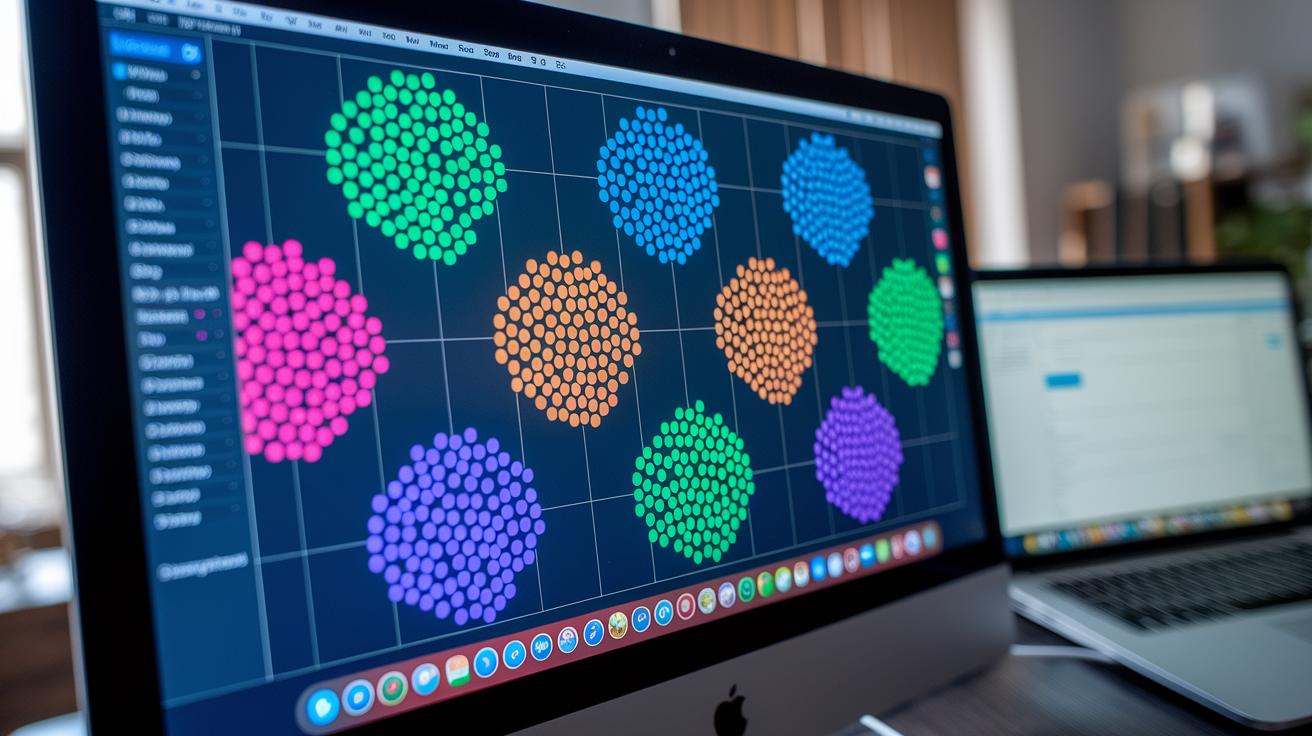
Picking the right clustering algorithm is a big deal in data science, it really shapes what you see in your data. Different methods help you look at your dataset from unique angles. For example, using k-means segmentation means you focus on finding the best center points for your clusters. Meanwhile, hierarchical grouping builds a tree-like diagram to show how everything connects. Think of it like sorting a deck of cards based on color, number, or suit; the way you choose to sort them changes the whole picture.
K-Means Segmentation
With k-means segmentation, you start by picking some initial center points based on your data. Then, point by point, you assign each data item to its nearest center. After that, you recalculate the centers, and this process repeats until things settle down and the centers barely move. Imagine sketching a rough picture and then slowly adding details until it’s clear and sharp. This method makes sure that each cluster centers around a value that really represents it, which is why many people like to use it for grouping data.
Hierarchical Grouping
Hierarchical grouping takes a different approach. It organizes data by either joining small groups together (called agglomerative) or by breaking one big group into smaller ones (called divisive). In the agglomerative style, every single data point starts on its own, and then similar ones combine using methods like single, complete, or average linkage. On the other hand, divisive techniques start with a large cluster and then split it into finer parts. Think of it as building a family tree where individual ties come together to form larger branches. This method even gives you a clear visual map, called a dendrogram, which shows how clusters evolve over time and makes it easier to understand complex datasets.
Data Preparation Steps for Effective Cluster Analysis
Getting your data clean and in shape is the first step to smart cluster analysis. Cleaning your data helps fix simple errors and mix-ups that might throw off your clusters. Plus, when your data is scaled right, distance measures (that is, the way we figure out how far one point is from another) stay as accurate as possible.
Next, handling missing values and choosing the most helpful features are key moves. When you take care of gaps in your data and remove bits that don’t add value, your clusters better reflect real patterns. In other words, the effort you put into cleaning, scaling, and filling in missing pieces means you get clusters that truly shine with insight.
- Data cleaning (removing outliers and fixing format errors)
- Handling missing values (using simple imputation methods)
- Feature selection (cutting out features that show little change or duplicate others)
- Feature scaling (using normalization or standardization so all features speak the same language)
- Encoding categorical variables (transforming non-numeric data into numbers)
Evaluating Cluster Analysis: Metrics and Visualization Techniques

When you dive into data science, it’s really important to see how well similar data points stick together. Tools like the silhouette score (which tells you if points in a cluster are close together) and the elbow method (a way to spot the best number of groups by looking at changes in the error rate) help us figure this out. You can also use friendly visuals like scatterplots, heatmaps, and tree-like dendrograms to naturally see the patterns that emerge.
Using these tools gives you clear, honest insights into how your clusters are doing and points out where you might want to tweak things a bit. It’s like checking the pulse of a busy market; you need to know if everything is moving in harmony or if there’s a hiccup somewhere.
| Metric | Purpose |
|---|---|
| Silhouette Score | Shows how tightly data points stick together and separate from others |
| Elbow Method | Helps pick the right number of clusters by checking the change in error |
| Davies-Bouldin Index | Calculates the average ratio of how close clusters are |
| Calinski-Harabasz | Compares differences between clusters and within clusters |
On top of these, the Gap statistic gives you another look at the space between what you see and what you might expect by chance. Scatterplots can show just how tight your clusters are, and dendrograms spell out the links and distances between each group. All these strategies work together to give you a well-rounded view, guiding you to refine your analysis and make smarter, insight-driven adjustments.
Practical Cluster Analysis Applications in Real-World Case Studies
Imagine you're shopping online and the website knows just what you like. E-commerce shops use cluster analysis to group customers by what they buy. For example, one group might love fitness gear while another prefers electronics. This smart grouping means that recommendations are more in tune with what you’re really after. And get this, a study found that stores using these techniques saw repeat purchases jump by over 15%. Cool, right?
Now, think about finance. Analysts use cluster analysis to spot odd patterns that could mean fraud or risk. In biology, researchers group genes to find hidden ties between species. Picture a system that catches unusual bank transactions or highlights rare gene groups linked to specific diseases. Even small differences in data can uncover big insights, making smart machines a trusted partner in many fields.
Businesses also turn to cluster analysis to break down tons of data into easy-to-understand chunks. This helps them tailor marketing campaigns to different customer groups, leading to more focused ads and better promotions. In short, grouping data like this not only improves targeting but also boosts overall performance by using resources more wisely.
Implementing Cluster Analysis with R and Python

Picking the right tools can make your cluster analysis a lot simpler. Both R and Python have easy-to-use yet powerful features that help you group data without any fuss. For example, in R, you can use commands like stats::kmeans() and hclust() to quickly sort your data. In Python, the scikit-learn library offers solid clustering options. Using these dependable tools means you can focus on turning raw data into smart, actionable insights.
R-Based Segmentation
When you're working in R, a great starting point is stats::kmeans(), which groups your data points around central points or centroids. Next, you can try hclust() for hierarchical clustering that organizes your data into clusters within clusters. Drawing out dendrograms helps you see how clusters connect, making patterns easier to spot. This step-by-step approach lets you adjust your model on the go and fine-tune your results for clearer accuracy.
Python Grouping Guide
In Python, you can use the KMeans class from scikit-learn to sort your data based on calculated centroids. Another tool, AgglomerativeClustering, works by merging similar groups in a step-by-step process. Simply call fit() to train your model and predict() to label new data points. These clear, simple commands make it easy to set up unsupervised techniques and quickly achieve smart grouping with minimal extra effort.
Final Words
In the action, we explored the basics and depth of cluster analysis. We looked at what it is, breaking down its key concepts and objectives using clear, everyday language.
We've also seen how different techniques, like k-means segmentation and hierarchical grouping, play a big role in an unsupervised learning approach. Practical insights into data preparation, evaluation metrics, and even working with R and Python were shared.
Enjoy applying these ideas as you boost your investment decisions with well-informed, data-driven strategies.
FAQ
What is meant by cluster analysis?
The term “cluster analysis” means grouping similar data points based on shared characteristics. It uses statistical techniques to reveal natural groupings and patterns among data without predefined labels.
What are some examples of cluster analysis?
An example of cluster analysis is customer segmentation in retail, where groups are formed based on purchasing behavior. This technique helps businesses tailor marketing strategies and improve product recommendations.
What are the different types of cluster analysis?
The types of cluster analysis include partitioning methods like k-means, hierarchical methods such as agglomerative clustering, density-based techniques, and model-based approaches. Each type uses a different method to group similar data points.
How is cluster analysis used in research, statistics, and data mining?
The use of cluster analysis in research, statistics, and data mining involves grouping data based on similarity. Tools built into programs like SPSS and R simplify these analyses, making it easier to uncover hidden patterns and insights.
What is the difference between cluster analysis and regression?
The difference lies in their goals: cluster analysis groups similar items without an outcome variable, while regression predicts outcomes by modeling relationships between variables. Each method serves distinct data analysis needs.