
Ever wonder if you really understand what you believe? Bayesian analysis helps you update your view using new information, turning fresh clues into better guesses. Instead of relying on fixed numbers, this method shows you how to adjust your take as details come in, just like grabbing an umbrella when you see dark clouds ahead. In this post, we chat about how Bayesian analysis offers clear, flexible insights that can change the way you see data.
Bayesian Analysis: Powerful Statistical Clarity
Bayesian analysis is like a friendly tool for updating what you believe when new clues come along. It moves away from those old, fixed-probability methods by showing you how to adjust your expectations on the fly.
Unlike the more traditional frequentist method that sticks to p-values and fixed data sets, Bayesian analysis uses a full probability spread to show what you believed before diving into new evidence.
At its core, there’s Bayes’ rule: P(θ|X) = P(X|θ)P(θ)/P(X). In simple terms, think of it like this: you start with a basic guess (called the prior), and then you check the actual results (the likelihood). That mix gives you a better, updated guess (the posterior). It’s a bit like expecting rain, then noticing dark clouds and high humidity, and finally deciding whether to grab an umbrella.
This way of thinking works especially well when things are random and unpredictable. It neatly mixes what you already know with what you learn as more information comes in, letting your beliefs shift with every new piece of data. From clinical trials to high-speed trading, Bayesian analysis helps make sense of probabilities in real time.
Fun fact: Before scientists started using Bayesian methods, they often misunderstood how data varied. Once they began updating their predictions with fresh info, their whole approach changed.
Comparing Bayesian Analysis to Classical Statistical Methods
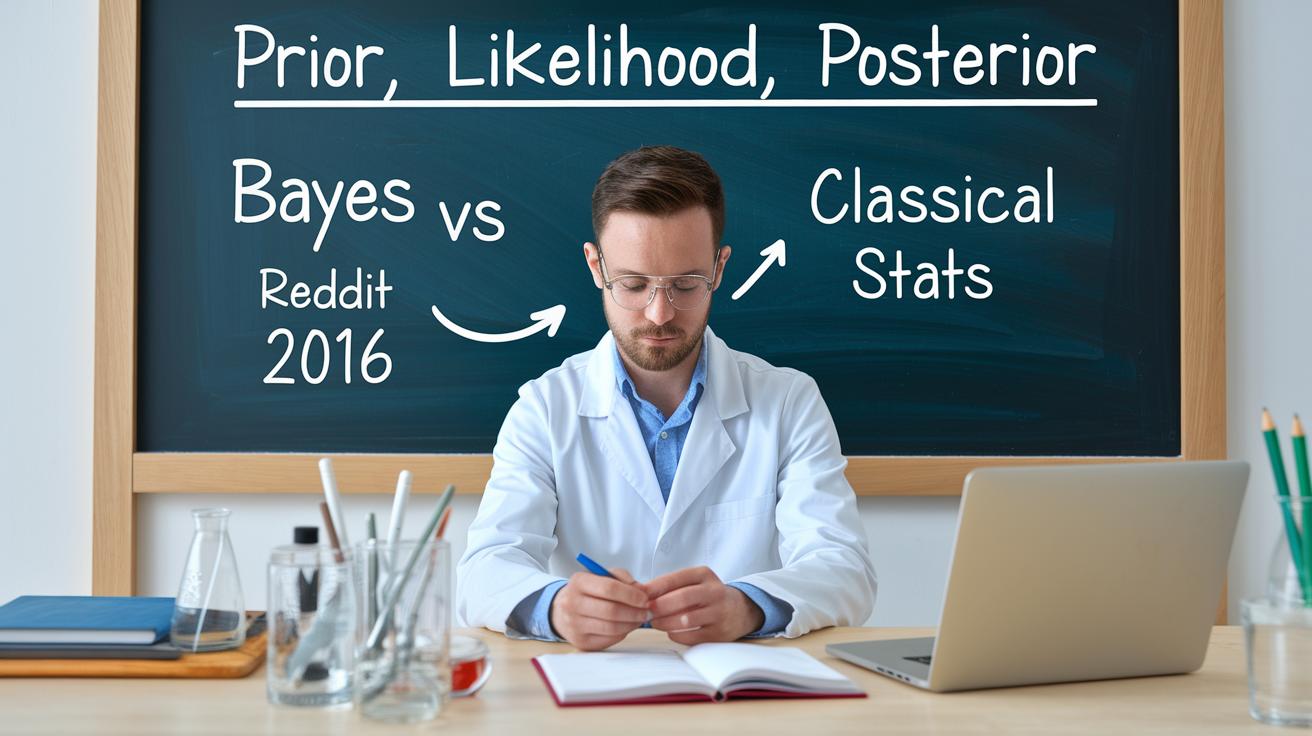
Bayesian inference is a flexible way to update what we believe based on new information. Instead of just crunching p-values or relying on fixed confidence intervals, you start with what we call a prior distribution, a kind of educated guess about a parameter. Then, as you gather fresh data, you look at the likelihood, like figuring out the chance of a coin landing heads. Using Bayes’ rule, these pieces come together to form a posterior distribution, which is just a fancy way of saying your updated belief that changes with every new bit of evidence.
Classical statistics, on the other hand, usually give you one fixed estimate that doesn’t change. Imagine flipping a coin several times: a classical method might say the coin is fair if heads and tails balance out overall. But with Bayesian analysis, every flip adds a little more detail to your estimation by mixing your initial guess with what you’re actually seeing.
| Method | Description |
|---|---|
| Frequentist | Takes the data as it comes and doesn’t mix in past assumptions. |
| Bayesian | Continuously updates its guess by combining earlier beliefs with new data. |
This constant updating really matters when your information is changing fast or when outcomes are up in the air. It’s like watching the pulse of a busy market, every moment brings a chance to see things differently. Have you ever felt that spark when the latest piece of news shifts your whole perspective?
Core Concepts in Bayesian Analysis: Priors, Likelihood, and Posterior
Prior Distribution
A prior distribution is like your first hunch about a value before you see fresh data. It’s built on what you already know. Sometimes you lean on history or expert advice (an informative prior) and other times you keep things open and neutral (a noninformative prior). Analysts often pick something called a conjugate prior because it makes the math easier. Imagine assessing a new tech startup’s potential by using performance figures from similar companies, even though the startup itself has no history.
Likelihood Function
The likelihood function shows how well different guesses match the data you’ve collected. Think of it as checking which story the numbers tell. In a coin flip test, for instance, a few flips leave you guessing broadly, but more flips narrow it down to a clear answer. Now, picture analyzing a series of stock closing prices. At first, the data might hint at many possibilities. But as more numbers roll in, you see a firm trend that sharpens your forecast.
Posterior Distribution
The posterior distribution is your updated view after mixing your initial hunch with the new data. It’s like recalculating your odds once you see fresh evidence. The math behind it blends your starting point and what you’ve learned (P(θ|data) = [P(data|θ)P(θ)]/P(data)). This approach is great for things like managing portfolio risk. Imagine looking at your mid-month sales report; with the new info, your confidence in the forecast gets a serious boost.
Computational Methods for Bayesian Inference and Simulation

Monte Carlo simulation is a practical way to learn about unknown parameters when finding an exact answer is too hard. Think of it like flipping a coin lots of times to see how often you get heads. You take many random samples until you start to see a clear picture.
Markov Chain Monte Carlo, or MCMC, builds on that idea by linking each sample to the one before it. It’s like passing a note from one friend to another, each note influenced by the one before. Popular MCMC methods include Gibbs sampling, Metropolis-Hastings, and Hamiltonian Monte Carlo. Gibbs sampling, for example, updates one variable at a time, which makes it great for models that have several layers. On the other hand, Hamiltonian Monte Carlo uses extra math, called gradient information, to explore tricky, high-dimensional spaces.
| Algorithm | Key Feature | Typical Use |
|---|---|---|
| Gibbs Sampling | Sequential updates of one variable at a time | Hierarchical models |
| Metropolis-Hastings | Accepting or rejecting new samples | Complex distributions |
| Hamiltonian Monte Carlo | Uses gradient info for smoother exploration | High-dimensional data |
Recent updates, like those in the “Bayesian Statistics: A Beginner’s Guide” for Python 3.8, have made these tools easier to use. Now, analysts using quantitative finance and machine learning can handle data challenges that older methods couldn’t crack. This means quicker, smarter ways to draw insights from complex data.
Real-World Applications of Bayesian Analysis Across Domains
In finance, traders use Bayesian methods to tweak their trading models as new market data come in. Imagine a trader who doesn’t just lean on past trends but also pays close attention to today’s market cues. This ongoing fine-tuning helps them keep risks in check and spot opportunities when conditions rapidly shift. For instance, one investment firm recalculates the chance of market changes after every trade, making sure their forecasts match the latest figures.
In clinical research, Bayesian techniques have made a real difference. In the REMAP-CAP trial, researchers used earlier studies to set up their expectations, sharpening insights into treatment effectiveness. Then there’s the EOLIA trial, which, when reexamined with a Bayesian approach, showed no 60-day mortality benefit compared to standard methods. These examples highlight how updating our beliefs with fresh evidence can guide life-changing decisions.
Coin-flipping examples, like Bernoulli trials, offer an easy way to see these ideas in action. In classrooms, a simple coin toss helps show how each flip adds a piece to the puzzle. Imagine saying, “Each flip gives you a new clue, slowly changing your view on whether the coin is fair.” It’s a straightforward way to understand how we adjust our beliefs bit by bit.
Machine learning also benefits from Bayesian thinking. Models built on these ideas keep refining their predictions by mixing past experience with incoming data. This process helps experts adjust complex networks used in everything from predictive analytics to comprehensive studies, turning Bayesian analysis into a trustworthy source for real insights.
Implementing Bayesian Analysis in Python and R Environments

In this section, we'll walk through a simple process to build a model, choose our starting assumptions (priors), run a sampler, and then check out the results. We'll do this using real code examples in both Python and R.
Python Implementation
Let’s start with the Python example. Here, we set up a basic scenario where we flip a coin. We use a Beta(1,1) prior, which means we start without any bias for heads or tails. Then we simulate and plot the posterior distribution to see how our beliefs change after seeing the data. Fun fact: Even a simple coin flip can reveal surprising details about hidden probabilities!
import pymc3 as pm
import matplotlib.pyplot as plt

# Build the model
with pm.Model() as coin_model:
    # Prior: Beta(1,1) shows no initial preference between heads and tails.
    theta = pm.Beta('theta', alpha=1, beta=1)

    # Likelihood: Bernoulli distribution for coin flip
    observed_data = [1, 0, 1, 1, 0]  # sample observations
    flips = pm.Bernoulli('flips', p=theta, observed=observed_data)

    # Draw samples from the posterior
    trace = pm.sample(1000, tune=500, cores=1)

    # Plot the posterior distribution
    pm.plot_posterior(trace, var_names=['theta'])
    plt.show()
R Implementation
Now, let’s move to the R example. Using RStan, we create a similar coin flip model. We first define our model using Stan’s language, and then we compile and sample from it. This example shows you how to get a snapshot of what the posterior distribution looks like in R, keeping things straightforward and hands-on.
library(rstan)

# Define the model with Stan's language
stan_model_code <- "
data {
  int<lower=0> N;        // number of coin flips
  int<lower=0,upper=1> y[N]; // coin flip outcomes
}
parameters {
  real<lower=0,upper=1> theta; // probability of heads
}
model {
  theta ~ beta(1, 1);     // Beta prior for theta (no bias towards heads or tails)
  y ~ bernoulli(theta);   // Bernoulli likelihood for the coin flips
}
"

# Prepare the data
data_list <- list(N = 5, y = c(1, 0, 1, 1, 0))

# Compile and sample from the model
fit <- stan(model_code = stan_model_code, data = data_list, iter = 1500, warmup = 500, chains = 4)
print(fit)
Best Practices and Common Challenges in Bayesian Analysis
First, choose a good starting point, known as a "prior." This is your initial guess. If you lean too much on strong assumptions without enough backup, your results might miss the mark. Instead, try using a gentle guess (a weakly informative prior) or ask experts who really know the field. For example, when checking a new treatment effect, lean on past data instead of an overly bold guess, this leaves room for surprises.
Next, see if your model is a good fit by comparing made-up data from your model with what you actually see. This check is called a posterior predictive check. Think about it like guessing a coin toss sequence in your head and then comparing it with your real coin tosses. If the two don't match up well, it might be time to adjust your model.
Another important point is convergence. Convergence means that your model’s output has settled into a steady state. To check this, use the R-hat statistic, which tells you if your samples are calm and consistent. When the R-hat value is close to 1, your model has balanced out. If it isn’t, you might need more sampling or a bit of a model tweak.
Finally, it’s key to compare different models. Tools like Bayes factors or criteria like WAIC (a simple way to measure which model fits your data best) can help you decide which model tells your data’s story more clearly.
- Choosing the right starting point with expert insight
- Checking your model by comparing simulated data to real data
- Confirming a steady state using the R-hat statistic
- Comparing models with tools like Bayes factors and WAIC
Each step helps build a clearer picture of your data and leads to smarter decisions.
Final Words
In the action, our discussion broke down bayesian analysis fundamentals and revealed its practical edge over fixed-probability methods. We examined how clear definitions of priors, likelihood, and posteriors shape decision-making, while highlighting computational tools in Python and R that streamline the process.
We also unraveled real-world applications that support risk management and up-to-date market insights. This hands-on look fuels smarter decision-making and secures personal financial practices. The future looks bright when smart analysis guides your path.