
Have you ever sat at your desk and thought about whether a simple table of numbers could forecast what lies ahead? A stochastic matrix does just that by laying out all the possible outcomes in a neat square where each row totals one.
Think of it like a pie chart, with every slice showing a different possibility. In this post, we're going to chat about how these matrices work and why every number must be zero or more. We'll walk you through the math using plain, everyday language so you can really see how chance plays out in real time.
Stochastic Matrix: Clear Math Definition
A stochastic matrix is a square table full of numbers where every value is zero or more, and each row adds up to one. Think of it as a simple guide for random events, the table shows the chances of moving from one situation to another. For example, with three possible outcomes, one row might be [0.5, 0.3, 0.2]. This tells you the chance for each state to come next.
Every number in this table is not negative because probabilities can’t be less than zero. Also, every row totaling one means that all possible outcomes are included. It’s like slicing a pie where every piece adds up to the whole pie. Even famous mathematicians have been amazed by how a rule as simple as “each row sums to one” can capture the complexity of chance.
Another cool thing about a stochastic matrix is that if you multiply it by a list of ones, the result stays the same. This neat trick confirms that the total probability doesn’t change when you move between states, making this matrix an important tool in understanding how things change in random processes like Markov chains.
Exploring Types of Stochastic Matrices: Right, Left, and Doubly Stochastic

Stochastic matrices come in a few different flavors because they help us model transitions in varied ways. Each type shows probabilities a bit differently, either by row, by column, or even both. This flexibility lets analysts pick the right mix for the problem at hand.
Right stochastic matrices are simple: every row adds up to one. Think of each row as a list of chances for moving from one state to the next. For example, a row like [0.4, 0.35, 0.25] means that the chances of moving to three different states add up perfectly to one. It’s neat how knowing each row sums correctly can give you a straightforward way to predict what might come next.
On the other hand, left stochastic matrices flip the focus. Here, every column totals one instead of each row. This setup is great when you’re more interested in seeing how probability stacks up from different sources into a single state. It’s a bit like turning the right stochastic matrix on its side, now you’re not so much forecasting the future as figuring out which events brought you here.
Then there are doubly stochastic matrices, which hit that sweet spot by keeping both rows and columns balanced at one. This type is especially useful when you need everything evenly distributed, imagine assigning tasks evenly among a team. It’s like having a perfectly balanced scale. In fact, math experts often break these matrices down into a sum of simpler parts known as permutation matrices, giving a clearer picture of how balanced assignments work.
Verifying Stochastic Matrix Properties
First, make sure all numbers in the matrix are zero or more. For example, if you see a row like [0.2, 0.3, 0.5], you can easily tell that every number meets this rule.
Then, check that the sum of each row (or each column for left stochastic matrices) is close enough to 1. Even if you get a total like 0.999999 or 1.000001, that tiny difference is fine because computers sometimes show these small errors.
One extra tip is to multiply the matrix by a vector made entirely of ones. If the result is the same all-ones vector, it confirms that the number 1 is an eigenvalue. This adds another level of confidence in your check.
Eigenvalues, Convergence, and Steady-State Distributions in Stochastic Matrices
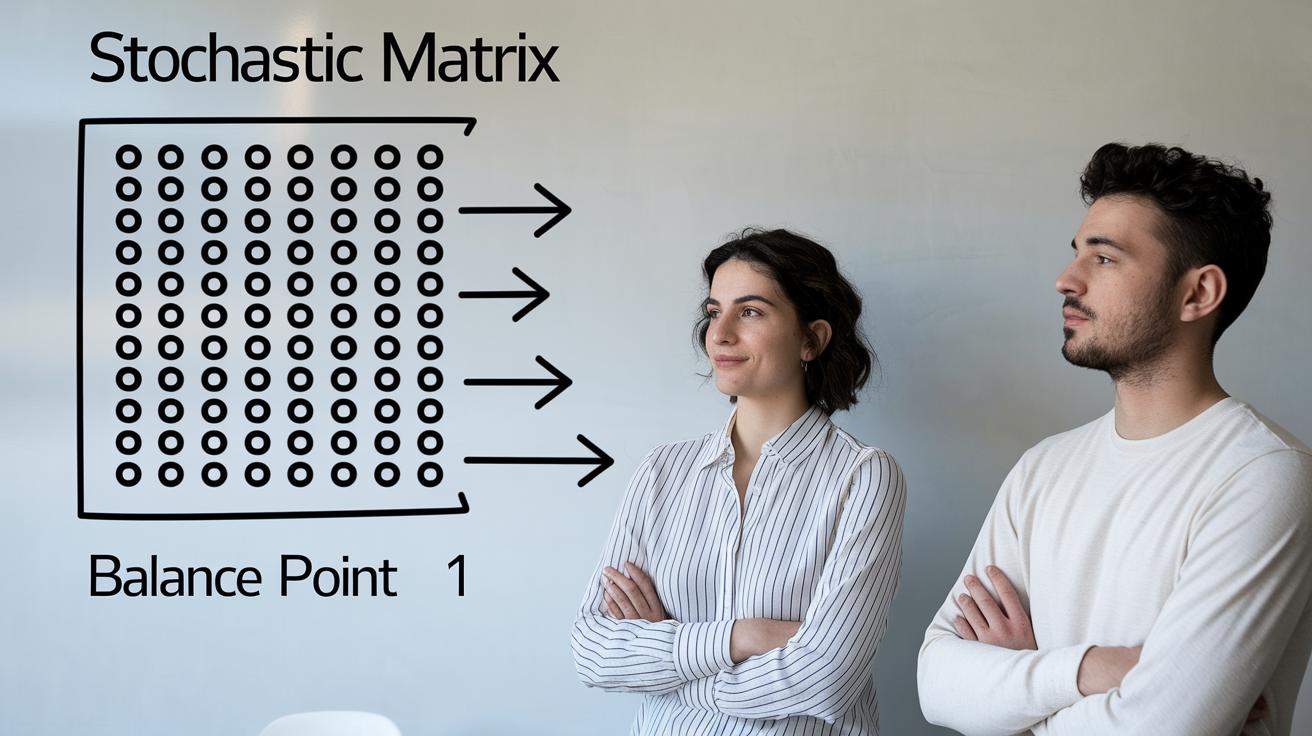
Every stochastic matrix has a neat feature: the number 1 always shows up as an eigenvalue. This happens because each row adds up to one. When you multiply the matrix by a column of all ones, nothing changes, pretty cool, right? It tells us that the all-ones vector sticks around unchanged, acting as an eigenvector with eigenvalue 1. Think of it as a balance point where the total probability stays the same, ensuring that a steady state exists.
Now, picture a regular, or primitive, stochastic matrix. When you multiply it by itself over and over, something interesting occurs. As the matrix raises to higher powers, the influence of the other eigenvalues slowly fades away. What remains is a unique, steady-state distribution, often called π. In simple terms, regardless of where you start, the system will settle into the same pattern over time. The pace at which this happens is set by what's known as the spectral gap, basically, the difference between that trusty eigenvalue 1 and the next largest eigenvalue. A bigger gap means the system finds its balance quicker. This idea is super important when you're looking at things like Markov processes, where knowing the long-term trend can make all the difference.
| Feature | Definition | Implication |
|---|---|---|
| Eigenvalue 1 | Each row sums to unity | Guarantees a steady state |
| Spectral gap | Difference: 1 – |λ₂| | Determines how fast the system converges |
| Steady-state π | Left eigenvector associated with 1 | Represents long-run distribution |
| Regularity condition | Matrix must be primitive | Ensures there’s one unique steady state |
Practical Applications of Stochastic Matrices in Markov Chains and PageRank
Markov chains are a classic example where stochastic matrices really shine. In these systems, each row in the matrix shows the chance of moving from one state to another, a bit like a board game where every move depends on a roll of the dice. You can think of it as each row listing all possible next moves along with the chance of each happening. This simple setup helps analysts get a feel for long-term trends and see how systems change over time, even when there are many possible outcomes.
PageRank, the ranking algorithm that helped shape the web, works with a similar idea using a special kind of stochastic matrix. Here, every web page gets a score based on its links, and the matrix neatly models the idea of a user jumping from one page to the next. Imagine browsing the web as if you’re flipping through a giant directory, every probability in the matrix reflects your chance of clicking a link. With this approach, the algorithm helps figure out which pages have more clout because they're better connected.
Stochastic matrices don’t stop there, either. They pop up in many other fields too. For example, in queuing systems they can show the flow of customers or data packets, while in population models they capture how people move between groups. In machine learning, hidden Markov models use these matrices to handle state transitions, and in economics, they help explain how probabilities stay balanced in financial frameworks. In each case, the math makes sure all outcomes add up nicely, keeping everything balanced and easy to track.
Final Words
In the action, we explored how a stochastic matrix defines probability structures in simple terms. We broke down the basic properties, examined different types like right, left, and doubly normalized systems, and outlined simple steps to verify these models. We also looked at eigenvalues and steady-state distributions and wrapped up with practical applications in Markov chains and PageRank. Each part of this discussion equips you with clear insights to ground your financial decisions using the primary keyword stochastic matrix. Enjoy putting these insights to work!
FAQ
What is a stochastic matrix example?
A stochastic matrix example is a square array with nonnegative entries where each row sums to one, often used in Markov chains to represent the likelihood of transitioning from one state to another.
How does a stochastic matrix function in a Markov chain?
A stochastic matrix in a Markov chain serves as the engine behind state transitions, ensuring that each row’s probabilities add up to one and guiding the system toward a steady-state distribution.
What makes a stochastic matrix regular?
A regular stochastic matrix is one that, when multiplied repeatedly, converges to a unique steady-state distribution, signaling a stable and predictable long-run behavior in the system.
What is a stochastic matrix calculator used for?
A stochastic matrix calculator is a tool that checks whether a matrix’s entries are nonnegative and if every row sums to one, confirming its validity as a probability transition matrix.
What defines a doubly stochastic matrix?
A doubly stochastic matrix is defined by having both rows and columns that sum to one, offering a balanced framework often used in models where inflows and outflows must be equal.
What are the eigenvalues of a stochastic matrix?
The eigenvalues of a stochastic matrix always include 1, with other eigenvalues indicating how quickly the process converges to a steady state, important for studying long-term behavior.
What are the key properties of a stochastic matrix?
The key properties include nonnegative entries and every row summing to one, ensuring that the matrix accurately represents probabilities and conserves the total probability.
What is a column stochastic matrix?
A column stochastic matrix is one where each column sums to one, typically used in models that emphasize incoming probabilities rather than departures from states.
What is the stochastic matrix?
The stochastic matrix is a square matrix with nonnegative entries and each row adding up to one, making it ideal for capturing state-to-state transitions in probability models.
How do you check if a matrix is stochastic?
You check if a matrix is stochastic by confirming that all its entries are nonnegative and that every row (or column, for left stochastic) sums exactly to one, meeting the criteria for valid probabilities.
What distinguishes a stochastic matrix from a regular matrix?
A stochastic matrix is distinguished by its strict requirements of nonnegative entries and rows summing to one, unlike a regular matrix which has no rules governing its values or sums.
What is an example of a stochastic model?
An example of a stochastic model is a Markov chain, where a stochastic matrix is used to indicate the probabilities of moving from one finite state to another over time.